The article that should have worked
Twelve months ago your team published a genuinely good article. It was well-researched. The angle was specific. The framework was original. You promoted it once on LinkedIn, sent it to your email list, and moved on to the next piece.
Today it gets forty-seven organic sessions per month. It ranks on page two for the primary keyword it was targeting. The sales team has never seen it.
Sound familiar? It should. Because the article is not the problem. The promotion is.
Most B2B marketing teams are running a creation-heavy, distribution-light operation — and they do not realise it until they stop and count. For every hour spent writing, editing, and publishing, most teams spend roughly twelve minutes distributing. That is an eighty to twenty split in the wrong direction. The result is a growing content library where individual pieces peak briefly on publication day and then quietly decay — while the team is already producing the next piece.
The instinct when results are flat is to publish more. More blogs. More LinkedIn posts. More webinars. More volume. That instinct is why teams feel buried and results stay stuck.
Here is the harder truth: you almost certainly do not have a content problem. You have a distribution problem. And the answer is not creating more — it is making what you already have work significantly harder before you create anything new.
This is the framework for doing that.
The imbalance no one talks about in team meetings
The distribution gap is not a secret. It is just not measured — which means it never becomes urgent enough to fix.
Research consistently shows that most content gets fewer than ten shares regardless of quality. Not because the content is weak. Because it is published once and never amplified again. The median outcome for a B2B blog post is near-invisibility — not because the article failed, but because the distribution system was never built.
Meanwhile, budgets are tighter than they have been in years. Most CMOs report lacking sufficient budget to fully execute their marketing strategy. For a solo marketer or small team, the choice between creating more content and making existing content work harder is not a philosophical debate — it is an economic necessity. You do not win by out-producing the market. You win by making what you have compound.
The eighty-twenty principle applies here precisely. In almost every B2B content programme, a small fraction of assets drive the majority of outcomes — traffic, leads, sales enablement, brand trust. The job is not to manufacture infinite new assets. The job is to identify the few that deserve to live longer and build the distribution systems that keep them compounding.
How Iriscale helps: Iriscale’s Opportunity Agent scans Reddit, LinkedIn, and social communities continuously — surfacing the specific conversations where your existing content is directly relevant and drafting engagement responses that distribute that content into the communities where your buyers are actively researching. Distribution that previously required manual daily monitoring becomes a reviewed, prioritised feed of opportunities.
Step 1: Run a ruthless content audit in 60 minutes
Most teams avoid content audits because they imagine a week-long spreadsheet exercise. It does not have to be. The purpose of an audit is triage — decide what to kill, what to keep, what to fix, and what to feature. Sixty minutes is enough to make those decisions for any content library under two hundred pieces.
What to pull:
Export your top organic landing pages, your top engaged social posts, and any non-CMS content — webinars, decks, presentations, podcast episodes. You are looking for three signals in every piece.
Performance signal: Which assets are driving consistent traffic over time (evergreen) versus which spiked on publication day and then flatlined? Consistent performers are your compounders. Spike-and-die pieces are either poorly distributed or poorly matched to search intent.
Relevance signal: Does this piece still reflect how your ICP describes their problem in 2026? A piece that was accurate eighteen months ago may be using vocabulary your buyers have moved on from, or addressing a problem that has been superseded by a newer, more pressing pain point.
Repurposability signal: Can this piece become ten or more channel-native outputs without creating new content? Any piece with a clear framework, specific steps, original data, or a strong point of view is atomisation-friendly. Generic overviews and definition-heavy articles are not.
The output: Four columns. Keep (distribute as-is). Refresh (update then distribute). Repurpose (extract atoms). Retire (remove or consolidate). If you cannot classify a piece in sixty seconds, it is probably not an eighty-twenty asset.
Step 2: Identify your three pillar assets for the quarter
Once you have audited, the trap is trying to distribute everything simultaneously. Attempting to amplify twenty pieces at once produces the same result as not amplifying any of them — nothing gets sufficient attention to compound.
Commit to three pillar assets per quarter for a small team. These are the three pieces that deserve your full distribution attention over the next ninety days. Everything else waits.
Three filters for selecting pillar assets:
Business fit. Does it speak directly to your ICP, your primary use case, and the deal cycles you actually want to close? If it attracts the wrong audience, distribution amplifies the wrong problem. Distributing a high-traffic TOFU piece to a BOFU audience wastes everyone’s time.
Proof or authority. Prioritise pieces that build credibility fast — case studies, original frameworks, specific outcome data, “how we did it” lessons from direct experience. B2B buyers do not need more generic advice. They need conviction and evidence from people who have done the work.
Format leverage. Choose assets that can become multiple formats without significant additional creation. A webinar becomes clips. A research-backed blog post becomes a carousel, an email series, and a LinkedIn narrative. A framework becomes a checklist and a Slack community answer. Assets with high format leverage are worth more per hour of distribution investment than assets that translate poorly to other contexts.
The two pieces you almost certainly already have:
A “how-to” post that ranks decently for its target keyword but has weak click-through rate and zero social distribution beyond the day it was published. This is the most common underperforming asset in B2B content libraries — a piece that Google has already validated as relevant but that has never been given the amplification it needs to compound.
A webinar with strong attendee feedback that was promoted once, generated its initial registrations, and was then archived. This is the highest-leverage repurposing opportunity in most content programmes — one good webinar contains twelve to fifteen standalone content atoms that most teams never extract.
Step 3: Build an eight-channel distribution playbook
Distribution is not “post on LinkedIn and hope.” It is a set of channel-native patterns that you execute every week, for every pillar asset, across every relevant channel. The patterns are repeatable. The content changes. The system stays constant.
Channel 1: Website and SEO (owned)
The highest-ROI distribution move for any underperforming article is a targeted refresh and re-launch. Update the examples, add internal links to newer related content, improve the heading structure for AI search citation, add an FAQ schema-marked section, and republish with a clear “updated for 2026” signal.
An article that was published and forgotten twelve months ago, refreshed and redistributed, often outperforms a brand new article — because it already has ranking history, crawl priority, and some degree of topical authority built in.
Iriscale’s contribution: Iriscale’s Search Ranking Intelligence identifies which existing articles are in positions eleven through twenty — one targeted update away from page one — so refresh priority is driven by ranking data rather than editorial intuition.
Channel 2: Email newsletter (owned)
Turn one pillar article into a three-part email mini-series. Do not send a link with “read our new article.” Send the insight directly.
- Email one: The problem, stated specifically in buyer language
- Email two: The framework, distilled into five actionable steps
- Email three: A specific example or outcome, with a soft CTA
The three-part series gets three times the distribution reach from one piece of content — and the readers who open all three are your highest-intent subscribers.
Channel 3: LinkedIn — executive and brand accounts
LinkedIn is the highest-ROI social platform for most B2B SaaS distribution — particularly when the founder or a senior team member posts in a personal voice rather than the brand account alone.
One pillar article should produce eight LinkedIn posts — each with a different hook and a different angle on the same underlying insight.
Formats that travel furthest: Point-of-view text post (strong opinion, no fluff), carousel (one insight per slide, save-worthy structure), “mistake we made” narrative (builds trust faster than success stories), and short native video clip (the forty-five to ninety second version of the webinar’s best moment).
The one rule: Write for saves and direct messages, not likes. Saves indicate the content is reference-worthy. DMs indicate it resonated enough to prompt a private conversation. Both are signals that the distribution is reaching the right audience.
Channel 4: YouTube and short-form video
Video continues to attract disproportionate engagement and budget allocation in B2B marketing — which means it is increasingly the distribution channel your competitors are not using effectively yet.
One sixty-minute webinar contains six standalone video clips. The structure for each clip: ten-second hook (the specific problem being addressed), forty-second insight (one specific point, not a summary of everything), ten-second CTA (what to do next, and why now).
Publish natively on LinkedIn, YouTube Shorts, and wherever your ICP is most active. Do not cross-post identically — adapt the caption for each platform’s community norms.
Channel 5: Sales enablement (internal distribution)
Your best distribution channel might be your sales team — and it is almost certainly your most underused one.
Turn your pillar assets into a reply library: a Notion document or shared Slack message with three to five annotated links, each with a one-sentence description of which buyer objection it addresses and when to use it in a sales conversation.
When a sales rep can drop a link to the right piece of content in thirty seconds during a discovery call, the content is doing real pipeline work rather than sitting in a content library that sales has never explored.
Channel 6: Communities — Reddit, Slack, and niche groups
Community distribution has the highest trust ceiling of any channel — but only when done correctly. The cardinal rule is answer first, link second. Summarise the insight directly in the community post. Offer the link as “the full breakdown” for anyone who wants to go deeper.
Communities penalise promotional posting immediately and reward genuine contribution over time. Iriscale’s Opportunity Agent identifies the specific threads where your existing content is directly relevant — so community distribution is targeted and timely rather than generic and calendar-driven.
Channel 7: Partners and co-marketing
Most partnership distribution is limited to logo swaps and joint webinars. The higher-value format is content distribution swaps — you provide a partner with three ready-to-post blurbs, one image, and a tracked link. They send it to their audience. You do the same for them.
The partner’s distribution reaches an audience that already trusts the recommender. That trust transfers to your brand in a way that a cold social post cannot replicate.
Channel 8: Micro-budget paid amplification
Paid amplification does not require a significant budget to produce meaningful results. A twenty to fifty dollar boost on the best-performing LinkedIn post variant — targeted tightly to your ICP by job title, company size, and industry — extends reach to buyers who match your audience but are not yet connected to your network.
The rule: do not boost until you have organic signal. Boost the LinkedIn post that is already getting saves and DMs — not the one you hope will perform. Amplify winners. Do not pay to distribute losers.
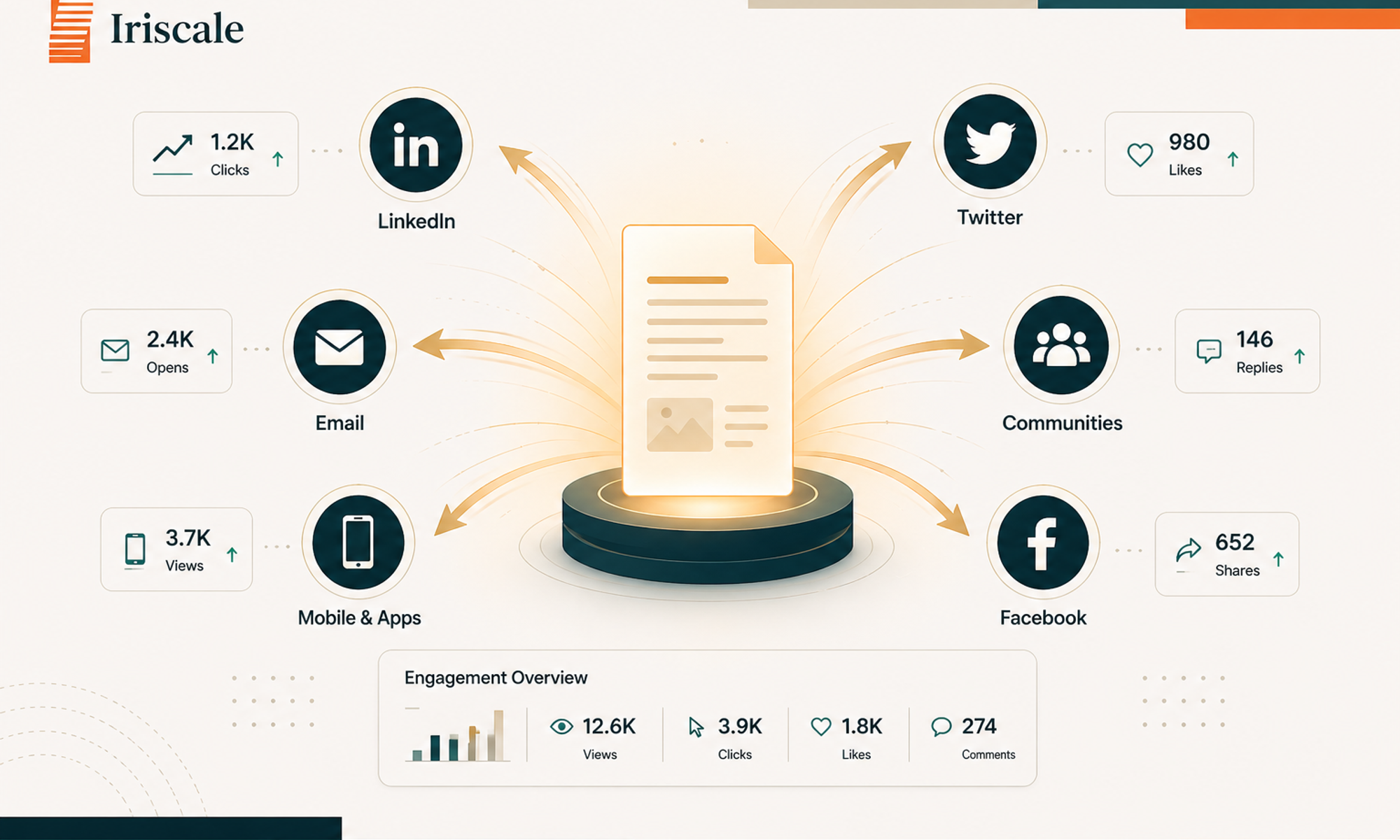
The target for every pillar asset: a minimum of twenty-four deliberate distribution touches across all channels — three email touches, eight LinkedIn variants, six video clips, three community posts, two partner placements, two sales enablement placements.
Step 4: Atomise — the content pyramid template
Repurposing is not making smaller quotes from a blog post. It is content atomisation — extracting multiple standalone assets from one pillar, each designed specifically for a different channel context.
The content pyramid:
Top (one piece): Pillar
Webinar, long-form guide, research report, or flagship case study
Middle (five to seven pieces): Spokes
- Five blog sections as standalone posts
- One checklist or template
- One “myths versus reality” post
- One customer story carousel
Bottom (twenty-plus pieces): Atoms
- Eight LinkedIn posts with different hooks
- Six short video clips (one insight each)
- Three email newsletter snippets
- Three community answer posts
- Two sales enablement reply templates
The question to ask before creating any new content: “Can we get thirty channel-native outputs from the last webinar or guide we published?” If the answer is no, the distribution system is broken — not the content calendar.
Step 5: Measure distribution like an operator
If your reporting dashboard shows impressions and likes, you are measuring dopamine. You are not measuring distribution.
A practical distribution measurement system answers three questions for every pillar asset: did it reach the right people, did it earn a click or next step, and did it keep working after week one?
Per-asset tracking:
| Metric | What it tells you |
|---|---|
| Reach by channel | Email sends, LinkedIn impressions, community views — where did the content travel? |
| CTR by channel | Email click rate, social link click rate, partner link rate — which channels convert interest into action? |
| Assisted conversions | Demo requests influenced, sales replies using the asset — is distribution producing pipeline? |
| Content half-life | Days until engagement drops fifty percent by channel — how long does each channel sustain performance? |
| Organic session curve | Sessions at thirty, sixty, ninety days — is the piece compounding or decaying? |
Two operator diagnostics:
If LinkedIn reach is high but CTR is low — your hook is working but your CTA or landing page alignment is weak. The audience is interested but not converting. Fix the CTA or the landing page before changing the content.
If email CTR is strong but conversions are weak — the content is resonating with the segment you are sending to, but the offer does not match what they are ready to do next. Route the engaged subscribers into a different nurture path rather than sending the same CTA harder.
How Iriscale helps: Iriscale’s Search Ranking Intelligence tracks whether distributed content is building organic ranking and AI search visibility over time — connecting distribution activity to the compounding organic outcomes that justify the investment.
Step 6: Install a distribution-first workflow calendar
Frameworks are only useful when they change behaviour. Here is the rule that changes the right behaviour: eighty percent distribution, twenty percent creation — until your backlog is actively working. Not forever. Until you have confirmed that your existing content is distributed, performing, and compounding.
Weekly distribution-first calendar:
| Day | Activity | Time |
|---|---|---|
| Monday | Pillar extraction — pull five to seven atoms from the pillar (quotes, steps, stories, frameworks) | 60–90 min |
| Tuesday | Social and community — publish one LinkedIn post, answer one community thread | 45–60 min |
| Wednesday | Email and sales enablement — ship one newsletter snippet, add one sales reply template | 60 min |
| Thursday | Video — cut two clips, write captions, publish natively | 60–90 min |
| Friday | Measurement and iteration — update dashboard, select next week's hooks based on CTR, saves, and replies | 45 min |
For a solo marketer: Three pillar assets per quarter. Each pillar runs a four-week distribution cycle before the next pillar begins.
For a small team: Rotate channel ownership. One person owns LinkedIn packaging. Another owns email sequencing. A third owns community and video. Everyone contributes to measurement Friday.
The ten-minute content audit checklist
Use this to triage any asset in ten minutes:
- [ ] What is it? (blog, webinar, case study, deck, podcast)
- [ ] Who is it for? (ICP, role, company size)
- [ ] What stage does it serve? (problem-aware, solution-aware, vendor-aware)
- [ ] What is the intended outcome? (lead, nurture, sales enablement, retention)
- [ ] When was it last updated?
- [ ] What is the current organic traffic? (thirty and ninety days)
- [ ] What is the current CTR from the top distribution channel?
- [ ] Does it have a clear, specific next-step CTA?
- [ ] Can it produce ten or more channel-native atoms?
- [ ] Decision: Keep / Refresh / Repurpose / Retire
Is Iriscale right for your team?
Iriscale is built for B2B SaaS marketing teams at the 50–500 employee stage who are ready to make their existing content work harder — with connected intelligence that identifies distribution opportunities, surfaces community conversations where existing content is relevant, and tracks whether distributed content is building organic rankings and AI search visibility.
If your content library is growing faster than your results are, if your best articles peaked on publication day and have not compounded since, if your sales team has never seen the content your marketing team is proudest of, or if your distribution system is “post once and move on” — Iriscale was built for exactly this.
Book a 30-minute walkthrough and see Iriscale’s distribution intelligence working on your actual content library, your actual community signals, and your actual organic performance gaps.
Frequently Asked Questions
What is the biggest distribution mistake B2B content teams make?
Publishing once and moving on. The median outcome for a B2B blog post is near-invisibility — not because the content is weak, but because it is promoted once on publication day and never amplified again. The teams that produce compounding organic results treat distribution as a four-week structured process for every pillar asset — not a single post on the day something goes live. One good article distributed across eight channels for four weeks consistently outperforms four mediocre articles each promoted once.
How do you decide which existing content deserves distribution investment?
Three filters. Business fit — does it speak to your actual ICP and the deal cycles you want to close? Proof and authority — does it contain specific, credible evidence rather than generic advice? Format leverage — can it produce ten or more channel-native outputs without significant additional creation? Assets that pass all three filters are your pillar candidates for the quarter. Assets that fail one or more should be refreshed, repurposed, or retired before being amplified.
What does content atomisation mean and how does it work?
Content atomisation is the process of extracting multiple standalone assets from one pillar piece — each designed specifically for a different channel context rather than being a copy of the original. A sixty-minute webinar becomes eight LinkedIn posts, six short video clips, three email snippets, three community answers, and two sales reply templates. A long-form guide becomes five standalone blog posts, a downloadable checklist, and a carousel. The goal is thirty channel-native outputs from one pillar investment before any new content is created.
How often should you redistribute the same content?
More than feels comfortable. Most of your audience did not see the content the first time it was distributed — LinkedIn organic reach is limited to a fraction of your followers, and email open rates mean most subscribers never read the original send. Re-promoting with different hooks and different formats every two to four weeks for the first quarter after publication is appropriate for pillar assets. Evergreen content can be redistributed quarterly with updated context for as long as it remains relevant.
What is the right ratio of creation to distribution for a lean content team?
Eighty percent distribution, twenty percent creation — until your existing content backlog is actively working. This ratio is not permanent. It is the intervention needed to break the habit of publishing into a distribution vacuum. Once your pillar assets are running four-week distribution cycles and producing compounding organic sessions, you can reintroduce creation as the dominant activity — but with a documented distribution plan attached to every new piece before it is published.
How does community distribution differ from social media posting?
Social media posting is broadcasting — you send your content to your followers and hope it travels. Community distribution is participating in conversations your ICP is already having — summarising the insight directly in the community, providing value without a mandatory link, and offering the full piece for those who want to go deeper. Community distribution earns trust because it demonstrates that you are there for the conversation, not just the click. Iriscale’s Opportunity Agent identifies the specific Reddit and LinkedIn threads where your existing content is directly relevant, so community distribution is targeted and timely rather than generic.
What is content half-life and how do you improve it?
Content half-life is the number of days until engagement drops fifty percent from peak after publication. Short half-life content — pieces that peak on day one and drop rapidly — is content that depends entirely on publication-day promotion rather than compounding organic discovery. Improving half-life requires two things: building the organic ranking that produces sustained search traffic after the initial promotion window closes, and structuring distribution as a four-week cadence rather than a single-day event. Iriscale’s Search Ranking Intelligence tracks organic session trends at thirty, sixty, and ninety days — surfacing which content is compounding and which is decaying before the signal is lost in aggregate traffic reports.
How does Iriscale support a distribution-first content strategy?
Iriscale supports distribution at three levels. The Opportunity Agent scans communities continuously and surfaces the specific conversations where existing content should be distributed — turning community engagement from a manual monitoring exercise into a prioritised, reviewed feed. Search Ranking Intelligence tracks whether distributed content is building organic rankings and AI search visibility over time — connecting distribution activity to the compounding outcomes that justify the investment. The Knowledge Base ensures that content distributed across channels maintains brand voice and ICP alignment — so the community answer, the email snippet, and the LinkedIn post all sound like they came from the same brand rather than three different writers working independently.
Related reading
- The Biggest Misconception About AI Content Tools
- Cross-Engine Visibility Share: The KPI That Compounds
- How to Evaluate AI Content Optimization Success
- Best AI Marketing Tools for Small Businesses
© 2026 Iriscale · iriscale.com · AI-Powered Growth Marketing for B2B SaaS