Iriscale
The one metric that predicts whether your content marketing will work — and it is not traffic
Content Marketing Playbooks

The one metric that predicts whether your content marketing will work — and it is not traffic

Dean Gannon
22 min read

The dashboard that lied to you last quarter

The content report looked good. Organic sessions were up fourteen percent. The top five articles were driving solid time on page. The team was publishing consistently and the trend line was pointing in the right direction.

Then the quarterly business review arrived. Pipeline was flat. Revenue missed. The CFO asked which content assets were influencing closed deals and the marketing team pulled up a GA4 dashboard that showed visits, bounce rate, and average session duration.

Nobody in that room could answer the question.

This is not an unusual story. It is the most common story in B2B content marketing. Teams optimise for what they can measure easily — traffic — and then discover that traffic was measuring the wrong thing all along. Not because sessions are meaningless. Because sessions measure what happened after a buyer clicked. They do not measure whether your brand was present when the buyer was forming their decision — which is the moment that actually determines whether they click at all.

In 2026, that pre-click moment is increasingly happening inside AI search engines. ChatGPT, Claude, Gemini, Perplexity, and Grok are where a growing percentage of B2B buyers are asking their category research questions, building their vendor shortlists, and framing the evaluation criteria they will use when they eventually reach a sales call.

None of that activity shows up in GA4. None of it shows up in your keyword ranking report. And if you are measuring content performance primarily by traffic, you are optimising for a shrinking slice of the discovery landscape — while the part that is growing fastest stays completely invisible.

The metric that fixes this is cross-engine visibility share. It measures whether you are present where decisions are being shaped — across Google and across AI search engines — before a buyer ever clicks anything. And unlike traffic, it compounds.


Why traffic is the wrong north star

Before making the case for a different metric, it is worth being precise about what is wrong with traffic — not so you can eliminate it from your reporting, but so you understand exactly where it misleads.

Traffic is a lagging indicator of a model that is changing

Traditional web analytics were built for a specific user journey: search on Google, click a result, arrive on a website, convert. That journey is becoming less common, not more.

AI search engines increasingly provide complete answers directly in the interface — summaries, comparisons, recommendations — without requiring a click to any website. A buyer who asks Perplexity “what is the best AI marketing platform for a 50-person SaaS team” may get a comprehensive answer that shapes their consideration set without visiting a single vendor website. That buyer’s research activity does not produce a session in anyone’s analytics.

When the click becomes optional, traffic stops being a reliable proxy for discovery. The funnel’s front door moved — and traffic data did not follow it.

Traffic measures quantity, not quality of audience

The most common content performance failure mode in B2B marketing is this: a team publishes top-of-funnel explainer content, wins significant organic traffic, and then discovers six months later that the traffic is composed primarily of students, researchers, job seekers, and competitors — not the VP of Marketing at a 100-person SaaS company who represents the actual buyer.

Traffic cannot distinguish between these audiences without significant additional analytics configuration. Visibility share — specifically, visibility share for high-intent queries like “best AI marketing platform for SaaS” versus informational queries like “what is content marketing” — naturally filters for commercial relevance because it is built around intent weighting.

Traffic is inconsistently measured across tools

If you are relying on traffic as your primary content performance KPI, you are relying on a number that changes meaning depending on how it is measured. Different analytics platforms apply different definitions of a session, different bot filtering methodologies, and different approaches to direct versus referral attribution.

This is not a minor discrepancy. Material differences in reported traffic totals between major analytics providers are common — differences large enough to change the strategic interpretation of a content programme’s performance. If your north star KPI changes shape depending on which tool you ask, it cannot be the metric you make headcount decisions on.

Traffic incentivises volume over intent

The most damaging consequence of traffic-as-north-star is the content strategy it produces. When teams are measured on sessions, they are incentivised to produce high-volume informational content that captures broad search demand — “what is,” “how to,” “definition of” — because these queries drive the most traffic.

This content is rarely where pipeline comes from. The queries that precede actual purchase consideration are lower volume, higher intent, and more specific: “best alternative to [competitor],” “[your category] for [specific use case],” “[your product] pricing for [company size].” These queries drive fewer sessions and significantly more qualified pipeline — but a traffic-first measurement system consistently deprioritises them in favour of the high-volume informational terms that inflate the dashboard and underfund the bottom of the funnel.


The superior metric: cross-engine visibility share

Cross-engine visibility share measures your share of meaningful query-level presence across Google and AI search engines, weighted by intent and topic importance, compared to your competitors for the same topic clusters.

It is the evolution of “share of search” — a concept that gained significant traction in marketing effectiveness research as a faster, more predictive indicator of brand health than sales data or brand tracking surveys. Share of search works because it captures real behaviour: when buyers move toward a purchase decision or reevaluate their vendor relationships, they search. The volume and direction of that search demand reflects genuine market movement before it appears in revenue data.

The traditional share of search model had two limitations. First, it treated Google as the only search surface that mattered. Second, it measured share at the keyword level rather than the intent cluster level — which means it could be gamed by targeting high-volume informational terms that did not represent commercial intent.

Cross-engine visibility share addresses both limitations.

Why “cross-engine” is not optional in 2026

AI search engines are not informational toys used by a fringe audience. They are increasingly the primary research interface for senior B2B buyers who are asking complex, comparative, evaluation-stage questions — exactly the questions that precede a vendor shortlist.

When those buyers ask ChatGPT which AI marketing platform is best for their team size, or ask Perplexity to compare two specific vendors, or ask Claude to help them build an evaluation checklist — your brand either appears or it does not. Your competitor either gets cited or it does not. That presence or absence shapes the consideration set before a single website visit occurs.

AI-referred traffic — the visitors who arrive from AI search engine recommendations — converts at significantly higher rates than average organic traffic. This makes intuitive sense: a buyer who arrived at your site because an AI engine specifically recommended you is further along in their evaluation than a buyer who found you through a broad informational search. The AI surface is not a brand awareness channel. It is a high-intent referral channel.

And critically: your visibility on that surface is not determined by your Google ranking. It is determined by whether your content directly and specifically answers the questions AI engines are being asked — which is a different optimisation problem than traditional SEO.

What cross-engine visibility share actually measures

To be precise about the metric: cross-engine visibility share is not average ranking position. It is not the number of keywords you rank for. It is not branded search volume.

It is share of presence — specifically:

  • Visibility across Google results including AI-influenced SERP features, featured snippets, and People Also Ask sections
  • Visibility in AI engines measured as citations, brand mentions, recommended sources, and quoted excerpts in AI-generated answers
  • Share-based framing comparing your presence to competitors’ presence for the same topic cluster and query set
  • Intent-weighted so evaluation-stage queries (“best alternative to X,” “Y for Z use case,” “pricing”) carry more weight than informational queries (“what is X”)

Together, these dimensions produce a metric that reflects your brand’s presence in the information layer where purchase decisions are increasingly initiated — not just the click layer where they are occasionally converted.


Why visibility share compounds where traffic does not

Traffic is linear at best. You publish content, it ranks, it drives sessions, those sessions convert at some rate. When you stop publishing, the pipeline stops flowing. When Google updates its algorithm, the sessions disappear. The gains do not build on each other.

Visibility share compounds because it drives a reinforcing cycle that traffic cannot produce on its own.

More presence creates more brand memory. A buyer who has seen your brand cited in three different AI search answers and two Google featured snippets over the course of their research process carries a stronger brand impression into the sales evaluation than a buyer who saw your site once after clicking a search result.

More brand memory increases branded search and direct demand. Buyers who have encountered your brand in AI search answers are more likely to search directly for you — increasing branded traffic, which converts at higher rates than non-branded traffic.

More branded demand improves performance across every channel. Email, paid, sales outreach — all of these channels perform better when the recipient already has a positive brand impression from prior research exposure.

Better channel performance funds more content and distribution. A content programme that is demonstrably producing pipeline earns more investment, which produces more content, which earns more visibility share.

That is compounding. Traffic produces a session count that resets every month. Visibility share produces a market position that accumulates over time — and that position is what determines whether your content strategy produces durable ROI or a treadmill.


The three patterns that separate compounding from resetting

After watching how content programmes perform across different measurement frameworks, three patterns emerge clearly.

Pattern 1: The traffic spike trap

A B2B marketing team publishes a series of high-quality top-of-funnel explainers. The content is genuinely useful and well-written. It ranks well for high-volume informational terms. Sessions climb. Leadership celebrates. The content team is rewarded for publishing more content like it.

Six months later, pipeline has not moved proportionally to the traffic growth. The sales team is getting leads from organic search but the lead quality is inconsistent — some are in the ICP, many are not. The CEO asks why content investment is not producing revenue and the marketing team does not have a clean answer.

The underlying problem: the content was optimised for volume (traffic) rather than intent (visibility share on commercial queries). The visibility that was being captured was mostly pre-ICP. The visibility that was not being tracked — presence in AI search answers for evaluation-stage queries — was going entirely to competitors who had optimised for it.

Pattern 2: The visibility share flywheel

A different team takes a different approach. They define a set of high-intent topic clusters — comparisons, alternatives, implementation, risk, pricing logic, vendor evaluation — and treat visibility share on those clusters as the primary content success metric.

They publish less content than Pattern 1. But the content they publish is specifically designed to answer the questions buyers ask when they are in evaluation mode — in Google and in AI search engines. They track whether that content appears in ChatGPT and Perplexity answers. They track whether competitor content is being cited in their place.

Over six months, their traffic growth is more modest than Pattern 1. But their qualified pipeline grows faster. When AI search starts sending referral traffic, it converts at a significantly higher rate because the buyers arriving have been specifically recommended by an AI engine that evaluated the category for them.

The difference is not writing quality. It is measurement philosophy.

Pattern 3: The invisible competitor

The most dangerous pattern for established content programmes is the one you cannot see in your current analytics.

A competitor — possibly a newer, less well-known brand — has been systematically building AI search presence for the evaluation-stage queries in your category. They are not outranking you on Google. Their traffic is lower than yours. By every traditional metric, your content programme is performing better.

But in every AI search answer for high-intent queries in your category, they are being cited. Their brand is being recommended. Their positioning is the default framing for how an AI engine describes the category.

A buyer who asks ChatGPT to help them evaluate vendors in your category gets a response that prominently features your competitor and mentions you briefly — or not at all. That buyer enters the sales process with a pre-built preference that no amount of organic traffic or email nurture can easily undo.

This competitor is invisible in your GA4 dashboard. They are very visible in the decision-making process of your buyers.

Cross-engine visibility share tracking is how you see this pattern before it reaches your revenue data.


How to shift the dashboard without starting a civil war

Changing KPIs is not an analytics project. It is a political project. Traffic is loved by leadership because it is simple, immediate, and visible. Cross-engine visibility share is better, but it requires a more sophisticated conversation about what marketing is actually trying to accomplish.

Here is how to make the shift without losing stakeholder trust.

Keep traffic — demote it

You do not need to remove sessions from the reporting dashboard. You need to stop letting sessions drive strategic decisions.

Traffic becomes a diagnostic metric: useful for investigating distribution changes, technical SEO issues, and seasonal patterns. It stops being the definition of content strategy success.

This is not a radical move. It is the same shift that happened when email open rates were replaced by click rates as the primary email performance metric — a recognition that measuring an upstream proxy was producing worse decisions than measuring the downstream outcome.

Replace “top pages” with “topic cluster control”

Traffic dashboards naturally elevate individual winning pages. One viral article becomes “the strategy.” This is how content portfolios accumulate disconnected outliers instead of building coherent topical authority.

A visibility share dashboard forces the team to think in clusters — not individual posts. The question is not “which article performed best this week” but “are we winning the topic clusters that matter commercially, across both Google and AI search engines?”

This reframe also makes content investment decisions easier to defend. “We need to publish three more articles to close the gaps in our AI evaluation cluster” is a more defensible argument than “we should publish more content because traffic is good.”

Build a governed keyword repository to end measurement debates

Internal measurement arguments almost always trace back to the same root cause: different stakeholders are measuring different keyword universes and each one can produce a version of reality that supports their position.

Sales wants to see “vendor + pricing” queries. Product wants “use case + industry” queries. SEO wants high-volume head terms. Without a single governed list of queries that the whole organisation treats as the measurement universe, visibility share becomes as contested as traffic.

The fix is a keyword repository: one governed set of queries, mapped to intent and topic cluster, used consistently across every reporting period and every stakeholder conversation. When you define the measurement universe once and enforce it consistently, the argument about “which keywords count” stops being a recurring waste of meeting time.

Iriscale’s Keyword Repository is built for this specific operational problem — a single source of truth for the queries your content programme is accountable for, connected directly to the visibility tracking that measures performance against them.

Add AI search tracking as a standard reporting layer

Most organisations currently treat AI search visibility as either a PR story (“we got mentioned in ChatGPT”) or an unknown (“we have no idea what’s happening there”). Neither of these is a manageable state.

AI search visibility needs to become a standard layer in your performance reporting — tracked systematically, compared to competitors, and connected to the topic clusters that drive your business.

Iriscale’s Search Ranking Intelligence tracks brand and content visibility across ChatGPT, Claude, Gemini, Perplexity, and Grok — in the same dashboard as Google keyword rankings. This is not two separate reporting workflows. It is one connected view of where your brand appears across the full discovery landscape.

Frame the cultural shift as competitive intelligence, not vanity tracking

The easiest way to get leadership buy-in on visibility share measurement is to frame it as competitive intelligence — specifically, the intelligence that tells you whether a competitor is gaining market presence in the discovery layer before it shows up in your pipeline data.

Revenue is a lagging indicator. Pipeline is a somewhat-less-lagging indicator. Visibility share is a leading indicator. When your competitor’s AI search presence starts growing in your category, you will see it in visibility share data months before you see it in win-loss rates.

That framing — “this is how we see competitive threats before they reach revenue” — is significantly more compelling to a CFO or CRO than “we want to track a new marketing metric.”


Objections you will hear — and the responses that hold up in a boardroom

A better metric does not win because it is right. It wins because it survives scrutiny. Here are the five objections you will encounter and the responses that keep the argument grounded.

Objection 1: “Visibility does not pay the bills. Revenue does.”

Revenue is the outcome metric. Visibility share is the leading indicator that predicts whether revenue is likely to compound. The question is not whether revenue matters — it is what leading metric best predicts whether revenue will grow. A metric that moves earlier than revenue and correlates with market direction is more useful for strategic decisions than revenue itself, which arrives too late to course-correct a content programme that has been building in the wrong direction for six months.

Objection 2: “If there is no click, how can it be valuable?”

Because influence precedes clicks. A buyer who has seen your brand cited in AI search answers during their research process carries a stronger brand impression into any subsequent interaction — search click, ad impression, sales outreach — than a buyer who has never encountered you. Influence is not the same as traffic. The absence of a click does not mean the absence of a brand impression.

Objection 3: “AI citations are unreliable, so measuring them is pointless.”

Citation unreliability is precisely why measurement matters. If AI engines are producing imperfect answers in your category — sometimes citing you accurately, sometimes not, sometimes citing competitors in your place — you need to know. The reputational and commercial risk of being consistently misrepresented or omitted from AI search answers is real. You cannot manage a risk you are not measuring.

Objection 4: “This is just rank tracking with extra steps.”

Rank tracking is page-level and Google-specific. Cross-engine visibility share is cluster-level, competitor-relative, intent-weighted, and spans multiple answer environments. The difference is the difference between knowing which page ranked position four and knowing whether your brand is winning the decision-stage conversation in your category across every surface where that conversation is happening.

Objection 5: “Stakeholders love traffic. They will not change.”

They will not change if you ask them to give up a familiar metric without offering a better story. The story is: traffic is a partial signal in a world where AI engines are answering buyer questions before a click is required. Visibility share tells you whether you are present at the moment decisions are being shaped. Traffic tells you whether some of those buyers clicked. Both matter — but they are not equal, and only one of them compounds.


The practical checklist: adopting cross-engine visibility share

  • [ ] Define your high-intent topic clusters — not keyword lists. Group queries by commercial intent and assign business weight to each cluster based on pipeline relevance
  • [ ] Establish a governed keyword repository — one agreed universe of queries, mapped to intent and cluster, used consistently across all reporting
  • [ ] Track Search Ranking Intelligence across Google and AI engines — ChatGPT, Claude, Gemini, Perplexity, and Grok — to quantify cross-engine visibility share for each cluster
  • [ ] Add AI optimisation to editorial workflow — structure content to answer the questions AI engines are being asked, not just to rank for keyword variants
  • [ ] Demote traffic to diagnostic — keep sessions in the dashboard, stop using them to make strategic investment decisions
  • [ ] Review visibility share monthly — compare to competitors, identify cluster gaps, prioritise content that closes the gaps in highest-intent clusters
  • [ ] Report visibility share alongside pipeline metrics — connect presence to commercial outcomes so the leading indicator is always validated by downstream data
  • [ ] Run a quarterly AI search audit — check how your brand is described and cited in AI search answers for your ten most important evaluation-stage queries

Is Iriscale right for your team?

Iriscale is built for B2B SaaS marketing teams at the 50–500 employee stage who are ready to move beyond traffic as their content performance north star — and who need a connected platform that tracks visibility across Google and AI search engines, manages the keyword architecture that structures their content programme, and connects visibility data to the content production workflow that improves it.

If your current reporting cannot tell you whether your brand is appearing in ChatGPT answers when buyers research your category, if your keyword strategy is producing traffic without pipeline, or if you suspect a competitor is gaining AI search presence that will reach your revenue data in the next two quarters — Iriscale’s Search Ranking Intelligence was built for exactly this.

Book a 30-minute walkthrough and see cross-engine visibility share measurement working on your actual topic clusters and your actual competitive landscape.

👉 Schedule a demo


Frequently Asked Questions

What is cross-engine visibility share and how is it different from traffic?
Cross-engine visibility share measures your brand’s share of meaningful presence across Google and AI search engines — ChatGPT, Claude, Gemini, Perplexity, and Grok — for high-intent queries in your category, compared to competitors for the same topic clusters. Traffic measures what happened after a buyer clicked. Visibility share measures whether your brand was present when the buyer was forming their decision — which is the moment that determines whether they click at all, and whether they do so with a positive brand impression or a neutral one.

Why does visibility share compound where traffic does not?
Traffic resets every reporting period. A session is a session — it does not build on previous sessions or make future sessions more likely. Visibility share accumulates. More presence across Google and AI search creates more brand memory. More brand memory increases branded search and direct demand. More branded demand improves conversion rates across every channel. Better channel performance funds more content investment. That reinforcing cycle is what makes visibility share a compounding metric rather than a linear one.

How do I explain cross-engine visibility share to a CFO or CRO?
Frame it as market presence at the moment of buyer intent. It measures whether your brand appears — across search and AI answer environments — when buyers in your category are evaluating their options. Revenue is the lagging outcome metric. Visibility share is the leading indicator that predicts whether revenue is likely to grow. Share-of-search research established this framework as a faster predictor of brand health than sales data because it captures real buyer behaviour before it reaches the revenue line.

Does cross-engine visibility share replace SEO?
No — it extends SEO into the AI search surfaces that traditional rank tracking ignores. Google ranking remains important and is part of cross-engine visibility share measurement. The extension is tracking how your brand and content appear in AI-generated answers across ChatGPT, Claude, Gemini, Perplexity, and Grok — surfaces that are increasingly influencing buyer decisions before any Google search occurs. Cross-engine visibility share is what happens when you treat AI search as a first-class measurement surface rather than an afterthought.

What content changes improve AI search visibility share?
Three structural changes produce the most consistent improvement. First, answer-first formatting — structuring content so the direct answer appears immediately after the relevant heading rather than buried in paragraphs of context. Second, entity clarity — naming your product capabilities, integrations, and use cases consistently across every piece of content so AI engines can build a coherent brand knowledge graph. Third, covering evaluation-stage queries — the “best alternative to,” “pricing for,” and “how to choose between” queries that AI engines are most frequently asked and that most directly shape buyer consideration sets. Iriscale’s AI Optimization Q&A reviews content against these criteria before publication.

How do I track AI search visibility share without building custom tooling?
Iriscale’s Search Ranking Intelligence tracks brand and content visibility across ChatGPT, Claude, Gemini, Perplexity, and Grok alongside Google keyword rankings in a single dashboard. You define your topic clusters and keyword repository once. Iriscale tracks your visibility share for those clusters across all five AI engines and Google continuously — surfacing where you are winning presence, where competitors are outperforming you, and which cluster gaps represent the highest-priority content investment.

How do zero-click searches change content strategy?
Zero-click searches — where the AI engine or Google answers the query completely within the search interface without requiring a click — do not eliminate the value of appearing in those answers. A buyer whose question is answered by an AI engine that cites your brand still receives a brand impression. A buyer whose question is answered without any citation of your brand still forms a view of the category — potentially shaped entirely by competitors who do appear. Zero-click behaviour makes click-based metrics less reliable and makes presence-based metrics more important. It does not make content strategy less important.

What is a governed keyword repository and why does it matter for visibility share measurement?
A keyword repository is a single, agreed set of queries mapped to intent, topic cluster, and business weight — used consistently across all content strategy and performance reporting. Without a governed repository, different stakeholders measure different keyword universes and produce incompatible views of performance. A content manager sees strong rankings on informational terms. A sales leader sees weak coverage on evaluation-stage terms. Neither is wrong — they are measuring different things. A governed repository defines the measurement universe once, making visibility share a stable metric that produces consistent strategic conversations rather than recurring arguments about which keywords count.


Related reading


© 2026 Iriscale · iriscale.com · AI-Powered Growth Marketing for B2B SaaS
Recommended

More from the same topics.

The Content Calendar Framework That Works for B2B Companies with Small Teams

The Content Calendar Framework That Works for B2B Companies with Small Teams

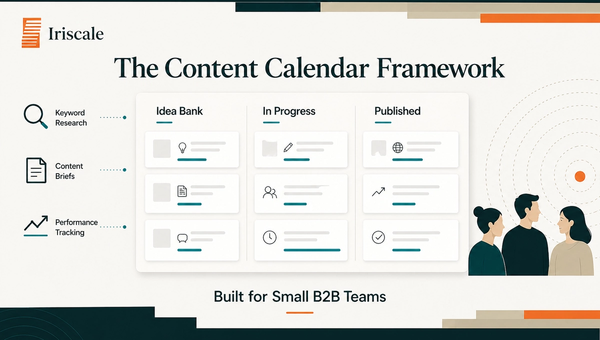
Build a Content Calendar That Actually Ships: The Search-Intent Framework for Lean B2B Teams Track what buyers search for, not what you hope to publish. A working content calendar starts with search intent, moves through a three-stage workflow, and lives in one workspace—so your 3-person team ships content that drives visibility without drowning in spreadsheets, meetings, or disconnected tools. Why enterprise calendars break small teams (and what works instead) Most B2B content calendars fail before the first publish date. You plan a quarter ahead, assign themes, lock dates—then reality arrives. A product launch pulls your writer. Sales needs a one-pager. Your subject-matter expert goes dark for two weeks. The calendar becomes a record of what didn’t happen. The problem isn’t discipline. It’s structure. Traditional calendars assume stable capacity, specialized roles, and coordination overhead—conditions lean teams don’t have. In 2025 B2B content marketing benchmark research (1,186 marketers surveyed), teams typically run with 2–5 dedicated people, and 24% operate without a dedicated content team at all [1]. That reality makes meeting-heavy editorial operations fragile. Tool sprawl compounds the issue. B2B teams commonly manage 8–12 tools across marketing and sales [2], [3]. Gartner reports marketers use less than half of their stack’s capabilities—utilization improved to around 49% in recent surveys [4]. You’re paying for complexity you can’t exploit. This guide provides a search-intent-driven content calendar framework that survives capacity changes, consolidates work into one workspace, and layers in automation. You’ll get a 5-day quick-start plan, a minimal tech-stack checklist, and a case study: a 3-person SaaS team that lifted organic traffic 40% and improved keyword rankings 3× after consolidating tools and automating updates. What to do next: Stop treating your calendar as a schedule. Treat it as a prioritized search-demand backlog that you schedule second. Step 1) Lead with search intent, not publish dates High-performing small teams don’t ask “What are we publishing Tuesday?” They ask: “What problems are our buyers solving right now—and what intent do they express when they search?” Here’s why it matters: date-first planning optimizes for output. Intent-first planning optimizes for outcomes—visibility, qualified sessions, pipeline contribution. Benchmark research shows content teams struggle to align content to the buyer journey and differentiate under resource constraints [5]. Intent-first planning is the simplest lever to improve relevance without adding headcount. How to build an intent-first backlog Cluster keywords and questions into four intent buckets: Problem-aware (pain + symptoms): “why is [process] slow,” “how to reduce [risk]” Solution-aware (approach comparison): “best way to do X,” “X vs Y,” “alternatives” Product/implementation (how-to): “how to implement X,” “setup checklist,” “templates” Proof/validation (risk reduction): “case study,” “ROI,” “security,” “pricing” Map each backlog item to: Primary keyword + 3–8 close variants Search intent statement (one sentence): “The searcher wants to…” Target reader role (RevOps lead, IT manager, finance) Conversion angle (demo, template, newsletter, contact sales) SERP expectation (guide, checklist, calculator, comparison) Examples for a B2B SaaS selling workflow automation “workflow automation examples” → problem-aware → needs inspiration + use cases → publish as a listicle with screenshots and mini-templates. “workflow automation vs scripting” → solution-aware → wants tradeoffs → publish as a comparison with decision table and constraints. “workflow automation rollout checklist” → implementation → wants step-by-step → publish as a downloadable checklist plus guide. Prioritize without bureaucracy Use a simple scoring model: Business value (1–5): Does it align to your ICP and revenue motion? Ranking feasibility (1–5): Can you realistically compete with your current authority? Effort (1–5): SME time, design needs, data needed. Prioritize by: (Value + Feasibility) − Effort. Your “calendar” becomes a ranked queue. Dates come later. What to do next: Write intent statements for your next 15 content ideas. If you can’t describe the intent in one sentence, the brief isn’t ready—don’t schedule it. Step 2) Run a three-stage workflow: Plan → Produce → Publish Small teams don’t need a 12-step editorial process. They need a process that survives interruptions and makes ownership obvious. A three-stage workflow does that—especially when your team is 2–5 people (a common reality in B2B content teams) [1]. The workflow Plan → Produce → Publish (with crisp definitions): Plan (clarity) Keyword cluster + intent statement Angle (what you’ll say that’s different) Outline + required inputs (SME questions, screenshots, data) Success metric (what “good” looks like) Produce (creation) Draft → revise → finalize Design assets (optional but deliberate) Internal review (time-boxed) Publish (distribution + measurement) On-site SEO checks (title, headings, internal links) Repurposing plan (LinkedIn post, email snippet, sales enablement) Tracking setup (search performance + conversions) Define “done” for each stage Calendars break when “Plan” becomes “we talked about it.” Fix that with definitions: Plan is done when: brief + outline + target keyword + CTA are in the workspace. Produce is done when: draft is editable by anyone and includes internal links to 2–3 related pages. Publish is done when: the URL is live and the repurpose tasks are queued. Assign roles without specialized headcount On a 3-person team, roles rotate. Use RACI-lite (one owner, one reviewer, one supporter) per piece: Owner: drives it across stages; no shared responsibility. Reviewer: gives feedback within 48 hours. Supporter: supplies SME input, visuals, or distribution. A weekly cadence that doesn’t require meetings Monday (30 min): backlog triage + select next 2 items Midweek (async): reviewer feedback Friday (20 min): publish checklist + performance notes for last week’s posts Many teams experiment with AI but only a minority integrate it into daily workflows [1], [5]. This workflow is the right place to insert AI support (brainstorming, outlining, first-draft assistance) without chaos: AI helps in Produce, while Plan and Publish remain human-led guardrails. What to do next: Create a single “Definition of Done” card for Plan/Produce/Publish and pin it in your workspace. If it’s not “done,” it can’t move forward—no exceptions. Step 3) Centralize keywords, briefs, and performance in one workspace If your “content calendar” lives in one tool, briefs in another, drafts in a third, and performance in a dashboard no one checks, you don’t have a calendar—you have a scavenger hunt. Tool sprawl is common: B2B teams often operate with 8–12 tools [2], and early-stage teams can juggle 10–20 tools [3]. Gartner’s reported utilization levels (around half of stack capabilities) underline the cost of this fragmentation [4]. What “one workspace” means Centralization isn’t forcing everything into one app. It means your team has one operational home where every content item has: the keyword and intent the brief and outline links to draft and assets status and owner publish URL and last-updated date performance snapshot + next action That one home can integrate with your CMS, analytics, and docs—but the command center is unified. The minimum data model Create a database/table with these fields: Content item (title/working title) Primary keyword Intent bucket (problem/solution/implementation/proof) ICP role Funnel stage (optional) Owner / reviewer Stage (Plan/Produce/Publish) Due window (week, not day—small-team friendly) CTA Internal links to add (2–5 target pages) Publish URL Performance (sessions, impressions, conversions—whatever you can reliably track) Next action (refresh, expand, build links, repurpose) Examples of centralized briefs that save time A brief doesn’t need to be long. It needs to prevent rework. Example: comparison post brief Intent: “Searcher wants to choose between X and Y and understand constraints” Angle: “Decision matrix by company size + compliance needs” Required inputs: pricing tiers, implementation time, security stance CTA: “Request a rollout plan” or “Download decision template” Example: implementation checklist brief Intent: “Searcher wants a step-by-step rollout” Angle: “90-day rollout with risk controls” Required inputs: SME to validate steps, one customer quote (if available) CTA: “Copy the checklist” (template) How Iriscale supports this (without creating more admin) At Iriscale, we built a unified workspace that keeps the entire lifecycle—keywords → briefs → AI-assisted drafting → publishing tasks → performance notes—in one place. Your “calendar” updates itself as work progresses. For small teams, the win isn’t “more features.” It’s fewer handoffs and less time lost reorienting across tools (context-switching is widely recognized as a productivity drag). What to do next: If a teammate asks “Where’s the latest brief/draft/performance for this piece?” more than once a month, centralization is your next project. Step 4) Automate repetitive updates and status tracking Small teams don’t lose because they lack ideas. They lose because they spend their best hours on status pings, link chasing, and manual updates. Consolidation trends in martech are accelerating under economic pressure and AI adoption [6]—automation is no longer “nice to have” when you’re running lean. What to automate first Automate tasks that are: repetitive rules-based easy to get wrong manually required for every piece Start with these: Stage change notifications When a card moves from Plan → Produce, notify reviewer + assign a due window. Brief-to-draft scaffolding Auto-create a doc outline with headings, FAQs, and internal link placeholders once the keyword is set. Publish checklist generation When status becomes “Ready to Publish,” spawn a checklist: metadata, internal links, CTA, tracking tags. Performance check reminders 14 and 45 days after publish, prompt: “Update performance fields + decide next action.” Repurposing tasks On publish, automatically create 2–3 distribution tasks (LinkedIn post, newsletter snippet, sales blurb). Keep automation from becoming another system to manage The trap is building fragile automations across five tools. The safer approach: keep triggers inside your primary workspace when possible use simple conditions (stage changes, due windows) avoid branching logic until the basics work If your team experiments with generative AI (common across B2B teams) but lacks formal guidelines (63% reported lacking AI guidelines in one benchmark report) [5], automation needs guardrails: AI can propose outlines and drafts humans must validate claims, add POV, and ensure brand voice any statistics or quotes must be sourced and reviewed Example: “evergreen refresh” automation Trigger: performance field shows declining impressions for 4 weeks (or manual flag) Action: create a “Refresh” task with checklist: update examples improve intro for intent match add 3 internal links add one new section addressing a common objection republish/update date (if appropriate) What to do next: Pick one trigger—“Stage changed to Ready for Review”—and automate only that this week. If it saves you 10 minutes per piece, it compounds fast. Step 5) Build intelligence layers: performance insights + gap analysis A calendar that only schedules production is half a system. The other half is learning: which topics drive qualified traffic, which pages need refreshes, and where you have coverage gaps. Benchmark research highlights attribution and ROI measurement as persistent challenges for B2B marketers [1], [5]. The fix isn’t a complex attribution model. It’s an intelligence layer that makes your next decisions easier. Intelligence layer #1: performance snapshots at the content-item level For each URL, capture a small, consistent set of metrics: Organic clicks/sessions Search impressions Top queries (3–5) Conversions you can trust (newsletter signups, demo clicks, contact form submissions—whatever is configured) Last updated Keep it lightweight. The goal is trend visibility, not perfect analytics. Example decision rules High impressions, low clicks → rewrite title/meta to match intent, improve above-the-fold clarity. High clicks, low conversion → adjust CTA and strengthen mid-article proof (mini case snippet, checklist). Declining impressions → refresh content, add internal links, expand missing subtopics. Intelligence layer #2: intent coverage map (your gap analysis) Create a matrix: rows = your core product categories or problems columns = intent buckets (problem/solution/implementation/proof) Fill in what exists. The blank cells are your highest-leverage content gaps because they represent buyer questions you’re not answering. Example (simplified) “Compliance automation”: problem-aware: exists solution-aware: missing (needs comparisons) implementation: missing (needs checklist) proof: missing (needs case study) Your calendar is now driven by a coverage strategy, not random ideas. Intelligence layer #3: content-to-pipeline annotations (small-team version) If full attribution is hard, use annotation fields: “Used by sales?” (Y/N) “Influenced deal?” (anecdotal notes) “Common objections addressed” (list) This aligns content with revenue reality without heavy ops. Platforms are moving toward unified, data-centric workflows [6]. At Iriscale, we built the intelligence layer directly beside the brief and draft—so you don’t need to “go find” performance every time you plan. What to do next: Add a “Next action” field to every published piece. If it’s blank, you’re not managing content—you’re just producing it. Step 6) Use a minimal tech stack (feature checklist + how Iriscale fits) A minimal stack isn’t “no tools.” It’s the fewest tools that cover the full loop: research → production → publishing → measurement → iteration. This matters because average teams already run many tools (often 8–12) [2], and utilization commonly lags capacity [4]. Small teams feel that gap as wasted time and brittle processes. The minimal stack: four capabilities (not four products) Choose tools (or one platform) that deliver these capabilities: Keyword + intent research (lightweight) capture keyword lists, clusters, and intent notes store competitor SERP observations (manual is fine) Brief + draft production reusable brief templates AI assistance for outlines and first drafts (with guidelines) version control and comments Workflow + automation Plan/Produce/Publish stages owners, due windows, checklists triggered task creation (review, refresh, repurpose) Performance + insights per-URL snapshot fields easy updates and reminders gap analysis views (coverage map) Lightweight stack examples Approach A: Unified workspace-first (recommended for small teams) One workspace that holds keyword research, briefs, drafts, tasks, and performance notes. Integrate your CMS + analytics. Benefit: fewer handoffs and less admin. Approach B: “Docs + board” setup A docs tool for drafts A board/database tool for calendar + automation Analytics as a separate reporting source Benefit: flexible, but risk of fragmentation and manual updates. How Iriscale consolidates the stack We built Iriscale as an all-in-one content workspace: centralizing the content calendar, keyword library, briefs, AI-assisted drafting, workflow automation, and performance tracking in one operating system—so your content strategy doesn’t collapse under tool switching. This aligns with broader consolidation trends: economic pressure plus AI is pushing teams toward platform-first decisions [6]. What to do next: Audit your content workflow and list every place a teammate must “go look” for information. Each extra destination is a tax. Reduce destinations before you add features. Case study: a 3-person SaaS team that lifted organic traffic 40% and improved rankings 3× A B2B SaaS company (mid-market workflow product) had a classic small-team setup: three people—a marketing manager, a content generalist, and a part-time designer. They published “consistently,” yet results were noisy: some posts spiked, most didn’t rank, and updates rarely happened. What wasn’t working Their content calendar was date-driven, planned a month ahead. Keywords lived in a spreadsheet; briefs in docs; tasks in a project tool; performance in analytics. Status updates took time, so the calendar was often wrong. They experimented with generative AI for drafts, but it wasn’t integrated into the workflow (a common gap—many teams experiment, fewer integrate into daily processes) [1]. The change: unified workspace + automation + intent-first backlog They rebuilt their system around this framework: Replaced date-first planning with an intent-first backlog Built 6 clusters tied to their ICP’s top problems. Wrote a one-sentence intent statement for every item. Adopted Plan → Produce → Publish definitions No brief meant no scheduling. Reviews were time-boxed to 48 hours. Centralized everything in Iriscale Keyword library + briefs + drafts + internal links + publish URLs + performance notes in one place. Automated repetitive operations Stage-change notifications Auto-generated publish checklists 14/45-day performance review prompts Repurposing tasks created at publish time Added an intelligence layer A coverage matrix across intent buckets “Next action” for every published URL (refresh, expand, repurpose) The results (over one quarter) +40% organic-traffic lift 3× improvement in keyword rankings (measured as a 3× increase in the number of tracked keywords appearing in top positions relative to their baseline) Faster iteration: older posts were refreshed on schedule because reminders and “next action” fields made it operationally easy. Why it worked The calendar stopped being a fragile schedule and became a prioritized system. Consolidation reduced the “where is that?” time sink (consistent with martech utilization challenges and the benefits of simplifying stacks [4]). Automation didn’t replace strategy—it protected focus by removing avoidable admin. AI helped with drafting speed, but intent and POV remained human-owned—reducing quality risk when teams lack formal AI guidelines (a reported issue in benchmarks) [5]. What to do next: If you only copy one thing from this case study, copy the rule: no date until the brief is done. It prevents 80% of calendar churn. Checklist: the lean content calendar framework (copy/paste) Use this as your setup checklist: Backlog (intent-first) [ ] Define 4 intent buckets (problem/solution/implementation/proof) [ ] Create 15–30 backlog items with one-sentence intent statements [ ] Score each item: Value (1–5), Feasibility (1–5), Effort (1–5) [ ] Prioritize by (Value + Feasibility) − Effort Workflow (Plan → Produce → Publish) [ ] Create three stages with “Definition of Done” for each [ ] Assign one owner + one reviewer per item [ ] Replace fixed dates with due windows (week-based) Workspace (single source of truth) [ ] Store keyword, brief, draft link, publish URL, and performance snapshot in one record [ ] Add fields: CTA, internal links, next action, last updated Automation [ ] Trigger review requests on stage change [ ] Auto-create publish checklist when “Ready to Publish” [ ] Schedule 14/45-day performance reminders Measurement [ ] Track organic clicks/sessions + impressions + conversions you trust [ ] Run a monthly intent coverage gap review Want a ready-to-use template? Create your workspace in Iriscale and start with the “Plan → Produce → Publish” database structure, then duplicate the fields above. Common questions about B2B content planning with small teams 1) How far ahead should a small B2B team plan content? Plan 2–4 weeks of production and 6–8 weeks of prioritized backlog. Small teams frequently get interrupted, so locking dates too far ahead creates churn. Keep the backlog stable and the schedule flexible (based on small-team constraints highlighted in benchmark reporting) [1]. 2) How many posts per week is realistic for a 1–3 person team? A sustainable target is 1 high-quality piece/week plus repurposing. Output depends on SME availability and format complexity (case studies and proof assets take longer than short articles) [5]. Consistency matters less than matching intent and maintaining refresh cycles. 3) Should we use AI to write first drafts? Yes—if you put guardrails in place. Many teams experiment with generative AI, but fewer have integrated it into daily workflow, and many lack formal guidelines [1], [5]. Use AI for outlines, structure, and drafting, then require human review for accuracy, POV, and brand voice. 4) What’s the single best metric to prove content is working? For organic content, start with search impressions + clicks/sessions, then layer in a conversion proxy you trust (demo click, signup, contact). Attribution is a common challenge in B2B content programs [1], [5], so use per-URL trend snapshots and sales feedback annotations until you can mature measurement. 5) How do we avoid tool sprawl while still being “data-driven”? Shift from “more dashboards” to one operational workspace plus a small set of performance fields. Industry reporting commonly notes average stacks in the 8–12 tool range [2], and utilization often underperforms capability [4]. Your best ROI comes from fewer tools used well—especially when the team is small. Build your calendar in 5 days (quick-start plan) Day 1: Create your unified workspace (one database/table). Add the required fields: keyword, intent, stage, owner, due window, CTA, publish URL, performance, next action. Day 2: Populate 20 backlog items from sales calls, support tickets, and existing keyword notes. Write one-sentence intent statements. Day 3: Build three brief templates (problem guide, comparison, checklist) and define “done” for Plan/Produce/Publish. Day 4: Add two automations: review request on stage change + publish checklist on “Ready to Publish.” Day 5: Publish one piece using the framework, then schedule 14/45-day performance reminders. If you want the fastest path to consolidation, request an Iriscale demo to see how the keyword library, briefs, AI-assisted drafting, workflow automation, and performance snapshots live in one place—so your small team spends time creating, not coordinating. Related Guides B2B Content Ops for Lean Teams: how to run reviews, SMEs, and refreshes without meetings Search-Intent Brief Writing: a repeatable brief format that prevents rewrites Evergreen Refresh System: how to update content monthly for compounding traffic Sources [1] https://www.themxgroup.com/wp-content/uploads/2024/10/B2B25_MX_Takeaway-REV.pdf [2] https://nytlicensing.com/latest/trends/b2b-content-marketing-2021/ [3] https://marketingsolutions.endeavorb2b.com/wp-content/uploads/2024/05/EBM24_Marketing_Benchmark_Report.pdf [4] https://databox.com/b2b-marketing-benchmarks [5] https://business.linkedin.com/advertise/resources/b2b-benchmark/2024 [6] https://multifamilystrategicmarketing.com/wp-content/uploads/2024/11/2-2024-State-of-Marketing-HubSpot-CXDstudio-FINAL-2.pdf

The Content Distribution Checklist: How to Amplify Every Piece You Publish

The Content Distribution Checklist: How to Amplify Every Piece You Publish

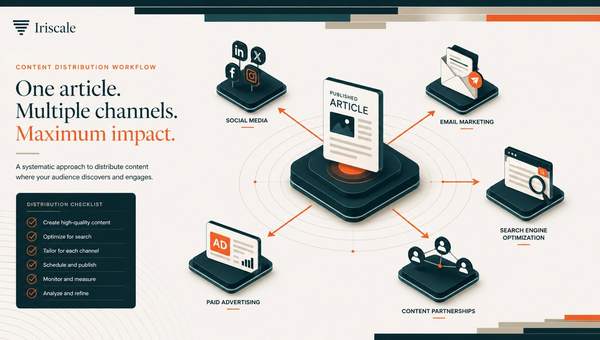
The Content Distribution Checklist: How to Amplify Every Piece You Publish Here’s what we see at Iriscale: teams ship strong content, then watch it disappear. The problem isn’t quality—it’s distribution. Organic reach has collapsed (Facebook sits around 1.1%–2.2% in 2024 [1]; LinkedIn organic reach is down 65% from peak [2]). This guide gives you a repeatable content distribution checklist to plan channels, timing, measurement, and governance—then operationalize it with Iriscale’s marketing intelligence platform. Overview Most teams still publish and pray: hit “post,” share once, move on. The result? One benchmark claims 80% of small business content gets fewer than 100 views without a distribution plan [3]. Meanwhile, buyers are overwhelmed—NetLine’s 2024 research found a 31.2-hour consumption gap between content request and actual engagement [4]. Translation: even when people want your content, you still have to architect how it will be found and trusted. A modern content distribution strategy is not a posting calendar. It’s a governed system that connects content architecture to business goals, selects owned/earned/paid channels based on audience behavior, sequences timing with data, automates workflows, and measures engagement to pipeline outcomes. What you’ll learn: How to map each asset to goals, audiences, and conversion paths How to choose the right owned/earned/paid mix with concrete channel examples How to sequence distribution over days and weeks to compound reach How Iriscale’s marketing intelligence platform automates, governs, and reports distribution at scale The exact content distribution checklist you can reuse for every launch 1. Map Content to Architecture & Goals Before you pick channels, define what the asset does in your system. At Iriscale, we treat each piece as a node in an architecture: a pillar page, a cluster article, a product narrative, a webinar, a case study, or a conversion asset. Content without a defined role creates two failures: distribution chaos (“share it everywhere!”) and measurement confusion (“we got views… now what?”). Start with a one-page distribution brief attached to every asset: Primary goal: awareness, subscriber growth, MQL/SAL, retention, expansion ICP and buying committee: who needs to see it and who influences Stage: problem-aware, solution-aware, vendor-shortlisting, customer enablement Core message & proof: one claim + one evidence point (stat, case proof, demo) Conversion path: next best action (newsletter signup, webinar, demo, trial) NetLine’s consumption-gap finding (31.2 hours) reminds us that “intent” doesn’t equal “attention” [4]. Your architecture should assume multiple touches are required. Concrete examples: SEO cluster article → email capture: Publish an article optimized for a high-intent query, embed a template CTA, route new subscribers into a short onboarding series (owned + SEO). Webinar → multi-format campaign: One webinar becomes 8–12 distribution units: a LinkedIn teaser clip, an email invite, a recap post, 3 short “lesson” posts, 1 gated replay landing page, and a retargeting segment (owned + paid). Case study → sales enablement + paid: Turn a case study into a 60-second vertical video for paid social and a 1-page PDF for SDR sequences. Next steps: Define one primary KPI and one secondary KPI per asset (e.g., “demo-starts” + “newsletter opt-ins”). Document “where this asset lives” in your pillar/cluster map so every distribution touch links to a coherent destination. Content Marketing Institute research emphasizes aligning strategy to organizational goals and audience needs [5]. Make that alignment explicit in your distribution brief so it can be governed and repeated. 2. Choose Owned/Earned/Paid Channels Strategically A checklist isn’t “post on LinkedIn, send an email.” It’s choosing the right mix for your asset role, audience, and objective—then aligning effort to expected reach. Organic social reach is harder than it used to be (Facebook 1.1%–2.2% organic reach [1]; LinkedIn reach down significantly from peak [2]). That doesn’t mean stop organic. It means stop treating organic as the only lever. Use this selection matrix: Benchmarks to ground decisions: Email remains a top owned channel: median B2B open rates around 36.7%–42.35% and CTR 2.0%–4.0%, with ROI estimates of $36–$42 per $1 spent [6]. LinkedIn paid benchmarks: sponsored content CTR around 0.44%–0.65%, with CPC around $5.58 [7]. Content syndication: one benchmark claims 6–8% lead conversion within 90 days and roughly half the CPL vs. some intent-only programs [8]. (Treat as directional; validate in your own funnel.) Concrete channel examples: Email + LinkedIn + retargeting: Send a newsletter feature (owned), post 3 LinkedIn angles over 10 days (owned/social), retarget page visitors with a short proof-based ad (paid). Syndication + nurture: Syndicate a gated version of a high-value asset for net-new leads (paid/partner), move them into a segmented nurture stream with the “next 3 best assets” (owned). Influencer earned + repurposed clips: Offer an influencer a co-created angle, repurpose the conversation into clips and quote cards to distribute across your channels. Sprout Social’s benchmarks emphasize authentic community-based influencer engagement over broadcast-only tactics [9]. Next steps: Choose one “anchor channel” (where your audience reliably pays attention) and two “support channels.” Avoid channel duplication: don’t post the same message everywhere. Create 3–5 “message angles” (problem, proof, objection, contrarian insight, how-to). 3. Optimize Timing & Cadence With Data Timing is not “best time to post” blog advice—it’s sequencing touches so the asset compounds. Because attention is fragmented, one-and-done distribution wastes the asset’s potential. NetLine’s consumption-gap research (31.2 hours) implies your audience may intend to engage but delay it [4]. Your job is to design re-encounters without spamming. A practical cadence model (B2B, per asset launch): Day 0 (publish): blog live + initial email or community post Day 1–3: LinkedIn post #1 (hook + promise) + sales enablement snippet Day 4–7: LinkedIn post #2 (proof + counterpoint) + newsletter “roundup” inclusion Day 8–14: short video clip or carousel + retargeting starts (if applicable) Week 3–4: republish angle as partner co-marketing or syndication; update internal enablement Channel-specific timing tips: Email: optimize for mobile—62% of emails are opened on mobile, and AI-driven personalization was associated with a 41% increase in revenue per email [10]. Use short subject lines, one clear CTA, and a “read later” fallback (save link). LinkedIn organic: engagement averages have modestly increased in some datasets (Statista cited average post engagement rising from 1.57 to 1.74 from 2024 to 2025 across 64,409 accounts) [11], but reach concentration remains real (top creators disproportionately benefit, and reach has been reported down from peak) [2]. Plan multiple angles rather than hoping one post hits. Paid: don’t launch paid amplification until you have early signal (e.g., above-median on-page engagement or strong email CTR). Then scale the winners. Two quick case snippets: Failure mode (publish and pray): A multi-brand team shipped 20 articles/month but only shared each once on LinkedIn. After 60 days, most posts produced minimal traffic, and sales couldn’t reuse the content because the message differed by brand. The fix was a single distribution brief + governed message library, then a 14-day cadence per priority asset. Success mode (sequenced amplification): A B2B SaaS team turned one webinar into a 3-week sequence: email invite → LinkedIn clips → partner newsletter → retargeting to replay. They saw replay attendance and demo requests increase because buyers encountered the same promise across multiple contexts. Next steps: Build a “minimum effective cadence”: at least 6–10 touches per priority asset across 2–4 weeks. Use data to cap frequency: if CTR drops or negative feedback rises, rotate angle/format instead of pushing harder. 4. Automate Distribution Workflows via Marketing Intelligence Even strong strategies fail when execution is manual. Scaling distribution across multiple brands typically breaks in four places: handoffs, approvals, inconsistent UTM/tagging, and fragmented reporting. CMI research shows 89% of marketers use AI for activities like brainstorming and summarization [12]—but automation without governance can create brand risk, duplicated posts, and measurement noise. This is where Iriscale’s marketing intelligence platform becomes operationally decisive: it doesn’t just “schedule posts.” Iriscale helps you automate and govern the entire content marketing workflow end-to-end, with human-in-the-loop controls. What to automate (without losing control): Distribution briefs → channel plans: Convert your architecture/goals into templated channel sequences (e.g., “SEO cluster launch,” “webinar campaign,” “case study push”). Asset packaging: Auto-generate channel variants (headlines, snippets, UTM links, creative requests) while keeping approvals human-led. Workflow orchestration: route tasks to owners (content, social, lifecycle, paid, PR, brand) with SLAs and dependency logic (“paid starts after creative approval”). Unified measurement: collect performance across channels into one campaign record so you can compare like-for-like and avoid spreadsheet attribution arguments. Iriscale differentiators: End-to-end platform: planning → activation → measurement in one system (less tool sprawl, fewer handoffs). Human-in-the-loop automation: AI accelerates variations and routing, while your team approves messaging, claims, and brand tone. This matters because trust is fragile; Edelman’s Trust Barometer highlights how innovation can introduce new trust risks [13]. Brand governance at scale: enforce naming conventions, required disclaimers, UTM standards, and message hierarchies across brands and regions. Unified data model: consistent taxonomy (campaign, asset, audience, stage) so reporting is comparable. Workflow illustration (what it looks like in practice): Content manager publishes the asset and selects “Distribution Template: Product Education (14-day).” Iriscale creates tasks: email module, 3 LinkedIn variants, syndication brief, paid retargeting audience build, and sales snippet. Brand/legal get routed only the items that require review (not every post). Once approved, Iriscale activates/syncs and standardizes tracking. Performance rolls up to a single view: reach, engagement, assisted conversions, and pipeline signals. Next steps: Standardize 3–5 templates (not 30). Templates drive adoption. Make governance invisible: embed rules into the workflow so teams don’t “forget” tracking or brand requirements. 5. Measure, Learn, and Iterate (Feedback Loops) Distribution is a system; measurement is the control plane. If you only report top-of-funnel vanity metrics, you’ll optimize for the wrong thing—and your team will lose confidence in the process. Demand Gen Report research shows many teams prioritize acquisition metrics like MQLs/SALs (48% citing them as key success metrics) [14]. That’s useful, but only if you also track leading indicators that explain why pipeline moved. Set up a KPI stack by funnel layer: Channel health (leading indicators) Email: opens, CTR (benchmarks often cited 2–4% CTR for B2B) [6] Social (organic): engagement rate, saves, comments-to-impressions ratio Paid: CTR (LinkedIn 0.44%–0.65% directional) [7], CPC, frequency, landing-page CVR Syndication: lead conversion rate within 90 days (directional 6–8%) [8] Content quality signals Scroll depth / time on page (where available) Return visits Assisted conversions (content touched before demo/trial) Business outcomes Subscriber growth and activation (e.g., first-week email engagement) Demo/trial starts, sales meetings booked Pipeline influenced / revenue (with attribution caveats) How to run the feedback loop: Baseline: define “expected ranges” per channel using your last 90 days plus external benchmarks as sanity checks [6][7]. Review weekly for priority assets: Which angles drove CTR? Which channel introduced the most qualified sessions? Diagnose: Was underperformance a message issue, audience mismatch, creative, or landing-page friction? Iterate quickly: swap headline/creative, change the CTA, adjust targeting, or repurpose into a better format. Two common objections (and fixes): “Attribution is messy, so measurement is pointless.” Fix: focus on directional lift and consistent taxonomy; compare campaigns to your own baselines. “We don’t have time to analyze.” Fix: automate dashboards and alerts. Iriscale’s marketing intelligence platform consolidates performance so insights don’t require manual exports every week. Next steps: Track one metric per channel that your team can influence weekly (e.g., email CTR, paid CTR, landing CVR). Build a “winner library”: store the top 10 hooks, CTAs, and formats by audience segment so you reuse what works. 6. Maintain Brand Consistency at Scale As you scale across multiple brands, regions, and teams, inconsistency becomes a distribution tax. The same asset gets described five different ways, UTM parameters fragment reporting, and claims drift—creating legal risk and eroding trust. Edelman’s trust research underscores that trust is sensitive to perceived credibility; inconsistency can undermine believability even when the content is accurate [13]. Meanwhile, AI makes it easier to produce variations quickly, increasing the need for governance (CMI reports broad AI usage in content workflows) [12]. A scalable governance model has three layers: 1) Message architecture (what can’t change) Core promise (one sentence) Proof points (approved stats, customer outcomes, demos) Positioning boundaries (what you do/don’t claim) 2) Brand expression (what should be consistent) Tone, terminology, capitalization rules Visual system (templates, safe zones, logo rules) Required disclaimers (industry/region-specific) 3) Local flexibility (what can change) Hooks and examples tailored to segment Channel-native formatting (threads, carousels, short clips) CTA variants by stage (subscribe vs. demo) Concrete examples of governance in distribution: LinkedIn post variants: allow multiple hooks, but enforce the same approved claim and CTA. Syndication briefs: enforce approved titles, bullet summaries, and lead routing rules so you don’t pay for low-quality handoffs. Sales enablement snippets: lock the “approved proof” block (numbers, outcomes), while allowing reps to personalize the opener. How Iriscale supports governance: Centralized message libraries and templates for each brand Approval routing that matches risk (e.g., regulated claims go to legal; simple social posts go to brand only) Enforced campaign taxonomy so cross-brand reporting remains consistent Human-in-the-loop review so AI-generated variants don’t introduce off-brand phrasing Next steps: Create a “distribution-ready” content package: 5 hooks, 3 CTAs, 10 approved proof bullets, and 6 visual templates per brand. Audit governance quarterly: sample 20 distributed posts and check consistency, tracking, and claim accuracy. Checklist Use this content distribution checklist for every asset: [ ] Asset role defined (pillar/cluster/enablement/conversion) [ ] Goal + primary KPI + secondary KPI set [ ] Audience + stage + next-best action documented [ ] 3–5 message angles written (problem, proof, objection, how-to, contrarian) [ ] Owned plan: email module + site placement + internal enablement [ ] Earned plan: partners/influencers/communities list + outreach snippet [ ] Paid plan: retargeting + audience + creative + budget guardrails (if needed) [ ] Cadence scheduled (minimum 2–4 weeks, 6–10 touches for priority assets) [ ] Tracking standardized (UTMs, naming conventions, campaign taxonomy) [ ] Governance applied (brand/legal approvals where required) [ ] Reporting view created (channel health + content quality + business outcomes) [ ] Post-launch review date set (7/14/30 days) with iteration actions Related Questions What’s the difference between a content distribution strategy and a content distribution checklist? Your strategy defines principles (audience, positioning, channel mix). The checklist turns that strategy into repeatable execution steps so every launch includes channel planning, tracking, and review. How many channels should you use per piece? For priority assets, aim for 2–4 channels with one anchor (often email or SEO) plus supports (LinkedIn, partners, paid retargeting). Multi-channel distribution broadens reach and can accelerate decisions, as HubSpot notes in its multi-channel guidance [15]. Is organic social still worth it if reach is declining? Yes—if you treat it as a sequenced system (multiple angles, formats, and employee/partner lift). But declining reach benchmarks (Facebook ~1.1%–2.2% [1]; LinkedIn reach down from peak [2]) mean organic should be complemented by owned and selective paid. When should you pay to amplify content? Use paid when speed, targeting, or retargeting is required—especially for conversion assets. Start with small tests; scale only after you see strong early engagement and landing-page conversion. How do you keep brand consistency across multiple brands and AI-generated variants? Use message libraries, templates, and risk-based approvals. Iriscale’s marketing intelligence platform with human-in-the-loop governance helps you move fast without letting claims and tone drift. CTA Want to operationalize this content distribution checklist across teams, brands, and regions—without turning your process into spreadsheets and status meetings? Iriscale helps you plan distribution architecture, automate multi-channel workflows, enforce brand governance, and unify performance data in one marketing intelligence platform—with human-in-the-loop controls where it matters most. Book an Iriscale demo or start a free trial to turn every launch into a measurable, repeatable amplification system. Sources [1] https://www.rebootonline.com/media/downloads/content-marketing-statistics-summary.pdf [2] https://contentmarketinginstitute.com/content-marketing-strategy/content-marketing-statistics [3] https://www.contentbycass.com/blog/40-b2b-content-marketing-statistics-you-cant-ignore [4] https://contentmarketinginstitute.com/b2b-research/b2b-content-marketing-trends-research-2025 [5] https://www.semrush.com/blog/content-marketing-statistics/ [6] https://nytlicensing.com/latest/trends/b2b-content-marketing-2021/ [7] https://www.mckinsey.com/capabilities/growth-marketing-and-sales/our-insights/five-fundamental-truths-how-b2b-winners-keep-growing [8] https://www.marketingprofs.com/charts/2024/50567/b2b-content-marketing-benchmarks-budgets-trends-outlook-2024-research [9] https://53a3b3d3789413ab876e-c1e3bb10b0333d7ff7aa972d61f8c669.ssl.cf1.rackcdn.com/DGR_DG283_SURV_ContentPref_April_2024_Final.pdf [10] https://www.linkedin.com/posts/techgeer_120-key-b2b-marketing-statistics-and-facts-activity-7269755971340554241-RnMO [11] https://campaignpros.io/learning-center/facebook-organic-reach-decline [12] https://www.facebook.com/UrbanFarm.Solutions/videos/facebooks-organic-reach-has-dropped-significantly-social-status-who-collate-mont/25982902594632226/ [13] https://www.facebook.com/smexaminer/posts/hows-your-organic-reach-on-facebook-in-2024-vs-2023-improving-about-the-same-or-/981076217396011/ [14] https://www.reddit.com/r/facebook/comments/198xpwj/why_is_facebook_reach_in_the_toilet_in_2024_why/ [15] https://medium.com/@jarrod-reque/why-organic-social-media-growth-is-so-difficult-today-c16da4969317